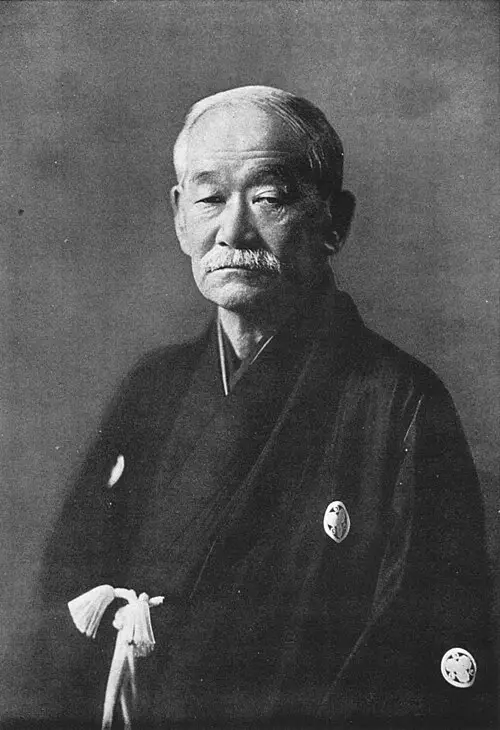
Jigoro Kano started the movement Master Shin, became my instructor when I was a young boy.
The MAI was founded in 1963 by Grandmaster Kyung Sun Shin, a world-renowned martial arts instructor & former competitor. Grandmaster Shin has produced thousands of highly skilled black belts. Schools affiliated with MAI can be found all over the United States, as many of Grandmaster Shin’s advanced black belts have opened first-class training facilities.
Jigoro Kano is recognized as the father of judo, having founded the martial art in 1882 and established its guiding principles of efficiency and mutual benefit.
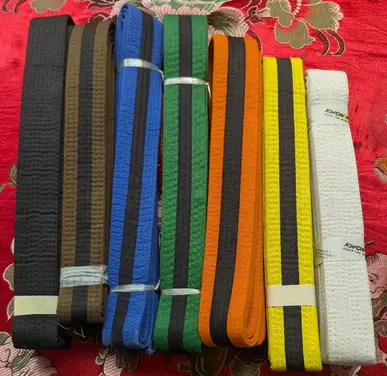
Yellow Belt requirements from age 4-11
The begining of your journey as a white belt begins with some agility training.
The Combat-Do system requires all students to understand that there are numerous throws to learn, and with each unique throw, you will need to develop the skills to fall properly and avoid injury. It is essential to practice these techniques diligently, as mastering the art of falling not only enhances your safety but also contributes to your overall effectiveness in executing throws. Ultimately, understanding the principles behind each throw and falling correctly will play a crucial role in your progress as a martial artist in the Combat-Do system.
Break Falls
There are several ways to perform a break fall effectively. The key to successfully executing all types of falls is to try and remain as relaxed as possible throughout the process. In the Combat-Do system, we refer to this state of relaxation as being in the water principle. This water principle emphasizes the importance of being loose and fluid like water, with no tension or rigidity in the body. By adopting this mindset, practitioners can improve their technique and minimize the risk of injury during falls.
The Forward Break Fall is a challenging technique that requires significant practice and skill to master. As a student learning this essential skill, it is crucial that you do not straighten your arms during the fall. Instead, you should focus on falling with your arms flat against the ground. This approach helps to distribute the impact more evenly and minimizes the risk of injury. Additionally, it is important to ensure that your knees and stomach do not come into contact with the ground during the fall, as this could result in discomfort or potential harm. Practicing this technique correctly will help you become more confident and proficient in your ability to perform falls safely.
The Rear Break Fall is as easy as simply sitting down. However, it should be executed in a relaxed, loose manner to ensure maximum effectiveness and safety. To perform this technique properly, it is crucial that you tuck your chin into your chest so that your head doesn’t collide with the ground during the fall. Additionally, your arms should be extended outwards and positioned in close proximity to your knees. It is important to prepare yourself for the landing by ensuring your hands are ready to absorb the impact. When you hit the ground with your hands, you will likely feel a sting from the force, but rest assured that if done correctly, you will not sustain any injuries. Practicing this fall regularly can help you build confidence and improve your ability to fall safely in various situations.
The Side Break Fall is performed by falling relaxed on your right or left side. In this technique, your arms are extended straight out and positioned close to your sides as you prepare to make contact with the ground. When you reach the ground, you slap the surface with your palms facing down to absorb the impact safely while simultaneously tucking your chin down towards your chest to protect your neck. This method is designed to minimize the risk of injury and ensure a smooth, controlled fall.
The Forward Roll is a simple yet fundamental somersault that anyone can learn with a bit of practice. However, it’s crucial to remember that when performing this move, you should never allow your head to hit the ground. Instead, you should smoothly roll onto your right or left shoulder, maintaining control and balance throughout the entire motion. This technique not only helps in preventing injuries but also enhances your overall agility and coordination.
Striking with Hands, Feet, Knees, and Elbows
Proper hand position when punching is absolutely vital to avoid injuring your hand and ensuring effective techniques. Your instructor will demonstrate exactly how to punch with maximum power by utilizing all of your body weight, which is essential for generating force. Additionally, through consistent practice and repetition, you will develop incredible speed and precision in your strikes, enhancing both your confidence and skill level in the process.
Kicking in the Combat-Do system begins with a fundamental technique known as the shin kick. As students learn to properly position their feet and turn their toes downward, they come to realize that this technique is not just effective but also serves as a powerful kick. By mastering this skill, they wield a formidable weapon that, when executed correctly, minimizes the risk of injury to themselves. Proper training and awareness ensure that they can use this technique confidently and effectively, enhancing both their performance and safety in combat situations.
The next kick in the system is known as the front snap kick. This powerful maneuver targets the groin area of an attacker, making it an essential move for self-defense situations. By delivering a fast and hard kick with the instep of your foot and ensuring that your toes are turned downward, you can maximize the impact and effectiveness of this strike. Timing and precision are crucial, so practicing this technique will enhance your ability to respond swiftly and decisively in a threatening situation.
The next crucial kick in the self-defense system is known as the back kick. This move begins with a step away, which creates the illusion that you are attempting to escape from your attacker. As you pivot, you will deliver a powerful kick targeted toward the attacker’s stomach. It’s important to note that you will be striking with the heel of your foot, which not only helps to avoid any potential injury to your foot but also allows you to generate a remarkable amount of force behind the kick. This technique, when executed properly, can create the distance you need to escape dangerous situations and effectively protect yourself.
In Close Fighting Elbows and knees
A couple of highly effective close-in weapons that you can utilize in self-defense situations are your elbows and knees. These powerful tools can deliver significant impact and can be very useful when you find yourself in a scenario where an attacker has grabbed you. During your training sessions, your instructor will teach you the proper techniques and methods for effectively using these weapons to defend yourself and escape from your assailant’s grasp.
Take-Downs and Throws
The motto of the Combat-Do Competition Team is, “It’s better to throw you than to know you!” This phrase encapsulates the essence of our philosophy and approach to martial arts. As a white belt, it is essential that you not only familiarize yourself with but also master a couple of the most widely used takedowns recognized around the world. These techniques include the Single Leg Takedown, the Double Leg Takedown, the Headlock Throw, and the One Arm Shoulder Throw. Each of these techniques requires practice and precision to execute properly, and they serve as the foundation for your growth and development in the sport. Understanding these moves will greatly enhance your skills and prepare you for more advanced techniques in the future.
Grappling Positions
The Mount Position (Tate Shiho Gatame) is a very tough position to get out of, making it one of the most challenging situations for grapplers of all skill levels. Learning the offensive tools and techniques associated with this position will give you a clear understanding of how crucial it is to avoid getting caught in the mount. It is extremely important that you dedicate time to learn and practice effective escape methods from the mount position, as mastering these skills will significantly improve your overall performance in grappling scenarios and protect you from potential submission attempts by your opponent.
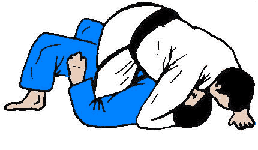
The Side Mount is an incredibly effective position that not only allows you to hold an attacker down with a significant amount of control, but it also opens up a wide array of submission options that can be utilized in various situations. Mastering this position can greatly enhance your overall ground game strategy and effectiveness. Additionally, learning how to escape from the side mount is a crucial skill that is often taught in grappling classes, as it empowers you to defend against potential submissions and transitions to more favorable positions on the ground.
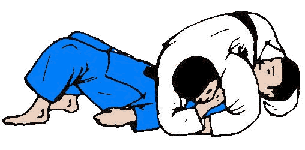
The Rear Mount is an exceptionally dangerous position to be caught in during a grappling encounter. You will notice that in this position, you are left weaponless, with no striking options available, making it imperative to escape as soon as possible to avoid being vulnerable. Successfully getting an opponent into a rear mount requires a combination of precise timing and exceptional skill, and once accomplished, it offers you a plethora of submissions and striking opportunities that can lead to a swift victory. Understanding how to maintain control while in this position and effectively utilizing your options is essential for any fighter looking to gain an advantage in a match.
The Guard Position (Dō-osae) is not only recognized as a highly effective defensive stance, but it also provides you with the opportunity to submit your opponent using an extensive array of different submission techniques. Throughout your training, your instructor will introduce you to several effective methods for passing the guard, particularly as you begin your journey as a white belt. As you progress through your training and advance through the various belt ranks, you will discover and learn many more techniques and strategies that will deepen your understanding of the guard position and enhance your overall grappling skill set.
Submissions
The Combat-Do system is designed to introduce you to the exciting world of grappling by teaching you four essential submissions.
Each of these submissions has been carefully selected to build your confidence and effectiveness on the mats.
Specifically, you will learn two powerful straight arm bars, one effective bent arm bar, and a highly efficient choke.
As you practice these techniques, you will develop greater body awareness and improve your overall grappling performance.
These fundamental techniques will not only help you get started in your grappling journey but also lay a solid foundation for more advanced skills and strategies in the future.
Understanding these principles will enhance your defensive capabilities and increase your chances of successfully countering your opponent.
You will also learn a four principled system to help you escape any submission attempt
.
This well-rounded approach ensures that you not only grasp individual moves but also understand their application in real-world scenarios.
Orange Belt for kids 4-11
To continue effectively working on essential agility skills, it is crucial that individuals focus on developing a range of movements. These include cartwheels, round-offs, and practicing standing on their heads. In addition, they should also dedicate time to mastering a diving roll over an object to enhance their overall agility. Furthermore, performing a handstand against a wall is not only beneficial but also a fundamental requirement for building strength and balance in the upper body, which contributes significantly to their agility training. Consistently practicing these skills will lead to noticeable improvements in agility and coordination.
Striking with Hands, Feet, Knees, and Elbows
Boxing and striking with hands As you progress towards achieving your next belt, it is crucial that you master the six count in boxing. This fundamental technique will not only enhance your skills but also improve your overall performance in the ring. Additionally, focus on executing a smooth and powerful backfist, ensuring that your movements are both deliberate and controlled. Practicing these techniques consistently will set a strong foundation for your advancement in boxing.
Kicking techniques encompass a wide range of various kicks that are essential for effective martial arts practice. Throughout your training, you will have the opportunity to learn the proper and refined methods to execute a turning kick, a side kick, as well as both inside and outside crescent kicks. Understanding and mastering these techniques will greatly enhance your kicking skills and overall performance in martial arts.
Elbow and Knee strikes
Elbow and Knee strikes are absolutely crucial to develop when engaging in close combat situations. Mastering these powerful techniques will not only enhance your ability to defend yourself effectively, but also significantly improve your overall self defense skills and confidence in confrontational scenarios. By incorporating these moves into your training, you will be better prepared to handle various types of attacks and protect yourself when it matters most.
Take-Downs and Throws
You have already learned about two impressive hip-technique throws, which are specifically classified under the category of Koshi Waza (Hip Techniques). These techniques include Ippon Seo Nage, which is known as the one-arm shoulder throw, and the Koshi Guruma, often referred to as the headlock throw. Both of these throws are fundamental in the art of Judo and provide a solid foundation for your skills. As you continue your journey in mastering these techniques, you will also be introduced to one more Koshi Waza technique called OGoshi, which is significant for developing your hip-throwing abilities. Additionally, you will learn one Te-Waza technique known as Tai Otoshi, which translates to the body drop. Furthermore, your training will your repertoire even further, you will discover an essential sweep technique called Deashi Harai, recognized in the category of Ashi Waza, meaning foot techniques. Finally, you will also learn about a reap technique, Ko Soto Gari, which is categorized as a minor outer reap, and is also classified as an Ashi Waza technique. This broadens your understanding and practical application of these crucial throwing techniques in your training.
Grappling Positions
Side Headlock position (Kesa Gatame) The headlock position is a particularly strong hold that provides you with a wide range of submission opportunities. Mastering this position requires maintaining a good perpendicular alignment with your opponent, ensuring that their head is raised and turned in the correct manner while also pulling their elbow across your body for maximum control. Additionally, it’s crucial that your weight is effectively distributed and dropped onto your opponent’s body to maintain dominance and pressure. During training, your instructor will guide you meticulously in getting into the proper position to not only secure the hold effectively but also to create opportunities for submissions that can lead to victory over your opponent. This technique is essential for any serious practitioner who wishes to enhance their grappling skills.
The North-South position, often referred to as a key element in grappling strategies, specifically highlights the effective application of the Kuzure Kami Shiho Gatame Hold Down. This position serves not only as a transitional phase but also emphasizes the crucial skill of maintaining dominant control over your opponent. When executed correctly, you unlock a range of potential submissions from this strategic stance. It is essential to apply an opposite and opposing force effectively, as doing so will allow you to secure your opponent in a tight position, thereby minimizing their ability to execute escapes and counter-movements. Mastering this position can significantly enhance your grappling game.
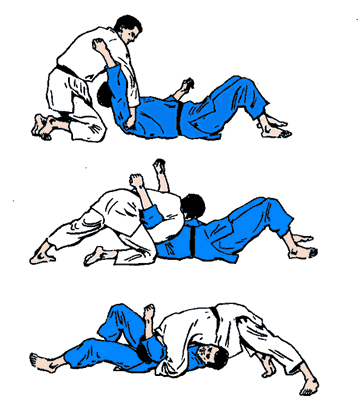
Open guard position is a highly flexible guard that allows for exceptional mobility, enabling you to effectively utilize both your arms and legs in combat. This versatility opens up a plethora of strategic options, making it easier to transition between various techniques, such as executing sweeps, achieving rear mounts, and initiating a wide range of submissions tailored to your opponent’s movements and reactions.
Passing the guard position effectively and successfully is a challenging aspect of grappling and Jiu-Jitsu. Getting out of a guard position can be an especially difficult procedure when your opponent has a strong and well-established guard. In this lesson, you will learn an array of techniques and strategies to PASS the guard successfully. Your instructor will guide you through some detailed step-by-step procedures that will help you navigate through an opponent’s guard, enhancing your skills and confidence on the mat. As you practice these techniques, you will gain a deeper understanding of leverage, timing, and the importance of positioning, which are essential components in overcoming your opponent’s defense.
Submissions
On your journey into the fascinating Combat-Do system, which explores the intricate science behind fighting techniques, you will have the opportunity to learn a substantial number of various submissions. As you embark on your quest to earn your orange belt, your training will include mastering two distinct submissions from kese gatame, two effective submissions from the mount position, two submissions from the closed guard, and two more from an open guard scenario. Additionally, you will delve into the techniques of straight arm bars and bent arm bars, along with mastering one effective choke from the advantageous rear mount position. Each submission technique is designed to enhance your skills and understanding of grappling, ensuring you are well-prepared for the challenges ahea
Green Belt kids ages 4-11
Agility moving quickly and smoothly
Agility plays a crucial role and continues to develop throughout your journey as a dedicated martial artist. The importance of footwork in both boxing and kickboxing cannot be overstated, as it serves as a fundamental aspect of effective training. The Orange Belt curriculum is specifically designed to guide you through a variety of drills that not only enhance your technique but also significantly improve your ability to flow seamlessly with fast and balanced movements, allowing you to become a more versatile and skilled fighter.
Striking with Hands, Feet, Knees, and Elbows
Boxing in Orange belt continues to build upon the foundational skills learned in previous levels, emphasizing the importance of footwork along with a strong concentration on the techniques of bobbing and weaving. Mastering footwork is crucial, as it enables students to move effectively while executing and combining various striking techniques, including jabs, crosses, hooks, and uppercuts. As students progress, it is time to start acquiring power and precision with these combinations, ensuring that each strike is not only delivered with speed but also with significant impact and control, ultimately enhancing overall performance in the sport.
Kicking In the quest to develop a comprehensive tool belt of various kicking techniques, during your journey as an orange belt, you will have the opportunity to learn not only how to execute a spinning back kick effectively but also to master an axe kick, a heel kick, and a front ball kick. Each of these kicks will enhance your skills and provide you with the versatility needed in martial arts.
Knees and elbows are crucial tools in close combat situations, particularly when grappling on the ground. Elbows, when utilized from a grounded position, can be incredibly effective in striking your opponent and creating space. Additionally, employing knees when you find yourself forced against a wall can be a vital tactic in a self-defense scenario, as they allow for powerful and close-range strikes that can disorient an attacker. Mastering these techniques will significantly enhance your self-defense capabilities, providing you with the confidence and skills needed to protect yourself in dangerous situations.
Take Downs and Throws
Take-Downs and Throws
The number one element in all fighting is the element of surprise.
Using feints or misdirection can trick your opponent into becoming overly confident, which opens up opportunities for you to execute your techniques.
It is not any different in throws and take-downs they should be smooth and fast.Fast is hard to counter, so as an Orange belt you will begin to learn the importance of setting up your opponent in order to surprise them.
You will also practice various setups that allow you to create openings by manipulating the opponent’s reactions.
The four throws that you will become proficient with Osoto Gari (Large Outer Reap), Uki Goshi (Floatin Hip), Sasae Tsurikomi Ashi (Lifting Pulling Ankle Block) and Hiza Guruma (Knee wheel) Always remember that the successful execution of a throw requires not only speed but also the element of timing.
Grappling Positions
There are numerous defined grappling positions that exist in every aspect of ground fighting. Different disciplines such as Wrestling, Judo, Jiu-Jitsu, and MMA all feature similar defined positions which are crucial to the success of the techniques employed. Understanding and being able to correctly name each position enables the instructor to efficiently guide their students in transitioning into the proper position to effectively perform various actions, including control, pins, submissions, reversals, and escapes. This knowledge not only aids in executing techniques but also enhances students’ overall understanding of grappling dynamics and strategy.
In learning the Orange Belt in the Combat-Do system, we will take a comprehensive and detailed deep dive into the numerous various ways to effectively utilize the Guard position in our practice. We will begin with an in-depth exploration of the Closed Guard, a fundamental position that serves as a strong foundation for our training. Your experienced instructor will provide you with extensive information about the closed guard, including its key principles, techniques, and strategic applications. Furthermore, we will cover transitioning from a closed guard to various other guard positions, such as open guard, rubber guard, spider guard, and butterfly guard. Each of these transitions will be explained thoroughly, allowing you to understand their significance and how to execute them effectively. This approach will enhance your skills and facilitate a better grasp of positional combat in the Combat-Do system.
“`
Submissions
Submissions in the green belt continue to progress impressively, showcasing a total of three notable submissions from the guard position. These include the Butterfly choke, which is a popular and effective technique, the Break the stick, which offers a unique approach to controlling the opponent, and the hammer lock, known for its effectiveness in applying pressure on the opponent’s arm. Furthermore, from the side mount position, there are two variations of bent arm bars along with one straight arm bar, highlighting the versatility and creativity in submissions from this position. Additionally, when transitioning into the mount, practitioners have successfully executed one bent arm bar, one straight arm bar, and one triangle choke, demonstrating a well-rounded skill set in grappling techniques and submissions that are essential for green belt level competitors.
As a Green Belt, it is essential that you fully understand the four fundamental principles that can help you escape from any submission hold. Mastering these four principles is crucial, as they will not only enhance your defensive capabilities but also give you a strategic advantage in grappling situations. The first principle is to clear the airway or neck when you find yourself caught in a choke; this is vital for preserving your ability to breathe and react before a blood choke puts you asleep. The second principle involves bringing your body to the center, which is critical for regaining a stable position and improving your leverage and combining your muscles making you stronger. The third principle focuses on extending your opponent away from their center extending them doesn’t allow them to come to center and now you are fighting half of the man, making them weaker creating an opportunity for you to escape or counterattack effectively. The fourth principle emphasizes the importance of following the path of least resistance, making it easier to escape from your opponent’s grip. By applying these principles consistently, you will develop a more comprehensive approach to defending against submissions Jiu-Jitsu or similar martial arts, submission wrestling, catch wrestling ,or Sambo.
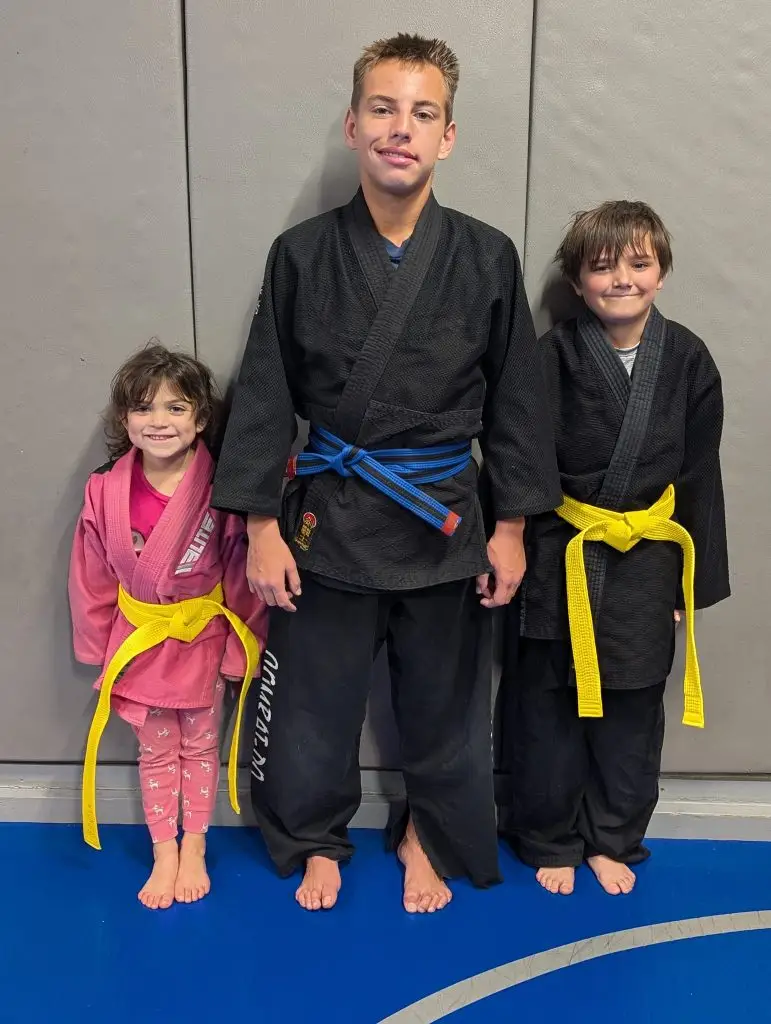
Blue Belt kids 4-11
Agility Training
As a blue belt in agility, you will embark on an exciting journey filled with new techniques and skills that will greatly enhance your abilities. You will learn how to perform a kip-up, a fundamental move that will help you transition quickly from a grounded position to an upright stance. Additionally, you will become proficient at turtling, which is a crucial skill for protecting yourself and repositioning during grappling situations. You will continue to practice performing a stationary handstand, and as you gain confidence, you will begin to learn how to walk on your hands, a key skill for advanced agility and balance. Furthermore, you will explore the dynamics of a forward handspring, refining your technique while also practicing an aerial, which is a visually stunning acrobatic move. To improve your overall flexibility and control, you will engage in back arching drills that are essential for throws and will help you feel more comfortable arching your body backward, setting the stage for learning to perform a back-flip confidently.
Striking with Hands, Feet, Knees and Elbows
Hands are the fastest tool in your arsenal of weapons there are five jobs of the jab that you will master and understand why you must know how to use each component of the five jobs. The distance between you and your opponent is measured by the jab so by throwing a fast jab at your oppoinent you can analyze how to use distance to complete the four other principles of using the jab. Reconnaissance is the next job, target areas on your opponent evaluate how your opponent moves do it in different locations on your opponent. Your opponent will normally move away in a similar pattern of movement this allows you to begin to set up your opponent. The set up can give you the opportunity to knock out your opponent using speed and body weight to generate a tremendous amount of power. The last of the five jobs is a check hand or post if your opponent attempts to rush you extend your jab locking it out creating a barrier that doesn’t allow your opponent to get inside.
1. Measure
2.Recon
3. Set-up
4. Knock out
5. Check
The kicks in blue belt include the spinning back hook kick, the calf kick and the slide side kick. Punching is all about combinations here is where you begin to develop your favorite three combinations of striking with hands and elbows.
Take-Downs and Throws
Harai Goshi is not just one of my favorite throws, but it is also a technique that embodies the essence of Judo. This impressive throw requires a great deal of skill, precision, and timing to successfully execute, resulting in a high amplitude throw that can catch opponents off guard. Another noteworthy throw, Uchi Mata, is similar in nature to Harai Goshi. It involves a strategic movement that goes beneath your opponent’s center of gravity, utilizing the back of your thigh to lift them off balance and propel them into the air. Both techniques demand practice and understanding of body mechanics to master, making them essential skills for any proficient Judoka.
Ko Uchi Gari Is a small inner reap very little movement of the leg transfer body weight from pulling and reap when your opponent pulls back.
Okuri Ashi Harai =Sliding Foot Sweep
Ko Uchi Gari= Small Inner Reap
Grappling Positions
The next five grappling positions come from a shot double or single leg, and your opponent sprawls. Look to the light, knee tap, Kelly, wing lock, Chuck by. From the top position, there are also three moves to take control and take your opponent’s back. Snap down, Rock-over, and Throw by. Your instructor will demonstrate each of these techniques, and you will drill them until you own the technique.
Submissions
The side control submissions will begin with one bent-arm bar, which serves as a fundamental technique, followed by one straight-arm bar and one more bent arm bar that build on the initial movement. From side control, there are three submissions that you will apply to the near side. You will learn to apply one bent-arm bar, one straight-arm bar, and one choke.
One of the primary advantages of the bent-arm bar is its ability to generate leverage with minimal movement, thereby enabling practitioners to maintain dominant positions and gain greater control over the opponent.
These submission techniques are crucial in Combat-Do Jiu-Jitsu and provide numerous opportunities for the practitioner to maintain dominant positioning.
Practitioners should focus on perfecting these techniques, as mastery can significantly enhance their overall game.
Many side-control submissions require practitioners to maintain dominant positions for effective application, and the chosen technique often depends on how the opponent responds to the side-control hold-down and on the openings created during the exchange.
Each submission requires keen timing and awareness, making practice essential for identifying the right moments to capitalize on an opponent’s misstep.
Understanding the various options available allows for greater adaptability and tactical decision-making in live situations.
Incorporating drills to practice these submissions in a live setting can help practitioners refine their skills and react instinctively during sparring sessions.
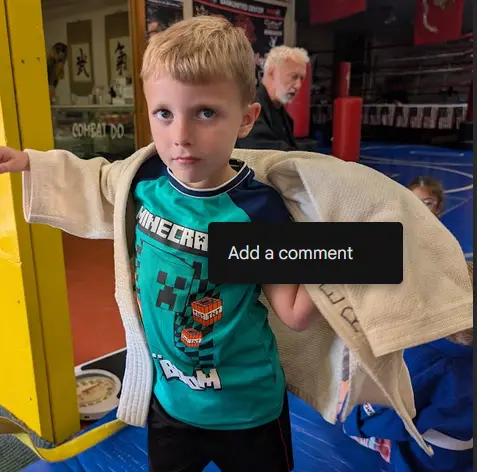

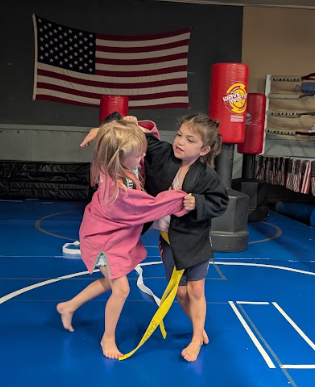
Oliver is getting ready to work on his orange belt
Brown Belt kids 4-11
Working on achieving a brown belt in the Combat-do system holds profound significance and meaning. You are no longer merely deciding that you wish to learn a few techniques in martial arts; instead, you have now fully committed yourself to a lifestyle dedicated to the rigorous pursuit of knowledge and personal growth in the ways of a warrior. This journey entails embracing discipline, understanding philosophy, and developing both your mind and body. As you progress in your training, you are transforming into Bushido, embodying the virtues and spirit that define the honorable warrior path. This commitment will not only shape your martial skills but also influence your approach to life itself.
Striking with Hands ,Knees, Feet and Elbows
There are many more kicking techniques in the Combat-Do System, and as you progress to the Brown belt level, you will begin to integrate and combine a variety of different kicks to create a more dynamic and effective attack. This progression allows you to explore and experiment with forming your own unique combinations, incorporating a total of five distinct techniques. Through practice and dedication, you will enhance your skills and develop a personal style that showcases your abilities in combat.
Takedowns and Throws
This page is Amazing